
This doctoral research explores the political economic conditions shaping access to COVID-19 vaccines across Southeast Asian countries.
In this presentation, Mutiara will provide an update on her doctoral research and share preliminary findings from her data collection. Drawing on insights from fieldwork and interviews, she will outline how she intends to use her data to examine the ways in which ideas, interests, and institutions shape inequitable access to COVID-19 vaccines across Southeast Asia. Her research focuses on three case countries: Singapore, Thailand, and Indonesia.
The presentation will offer a snapshot of the Phase 1 results, which map the regional vaccine access landscape and identify key policies and regulations in Indonesia, Thailand, and Singapore. From her interviews, several preliminary themes have begun to emerge. These themes highlight patterns in procurement strategies, technology transfer, regulatory capacity, institutional coordination, and external engagement.
The emerging data suggest that while each country’s approach reflects its unique political-economic conditions, shared dynamics are also evident across the region. The next steps will focus on refining these findings and developing greater analytical clarity as Mutiara progresses through the final years of her PhD journey.
This seminar is Mutiara's mid-term doctoral candidature presentation. It is a closed event for RegNet staff, visitors and students only.
About the speaker
Mutiara Indriani is a PhD candidate and Australia Awards scholar at the School of Regulation and Global Governance, the Australian National University. After obtaining a bachelor’s degree in social sciences from Ritsumeikan Asia Pacific University in Japan, she began her career at the ASEAN Secretariat in Jakarta, where she served in various divisions, including those under the sociocultural and political-security pillars. She holds a master of arts in international relations from Leiden University and a master of science from Uppsala University. She is also a Global Health Politics Fellow at the Frederick S. Pardee Center for the Study of the Longer-Range Future, Boston University.
COVID protocols
The ANU strongly encourages you to keep a mask with you at all times (for use when COVID-19 safe behaviours are not practicable) and to be respectful of colleagues, students and visitors who may wish to continue to wear one.
Please continue to practice good hygiene. If you are unwell, please stay home. The ACT government’s COVID Smart behaviours can be accessed here.
This seminar presentation is a dual-delivery event. Registration is not required for in-person attendance as neither the ANU nor ACT Health conduct contact tracing.
If you require accessibility accommodations or a visitor Personal Emergency Evacuation Plan please email regnet.communications@anu.edu.au.
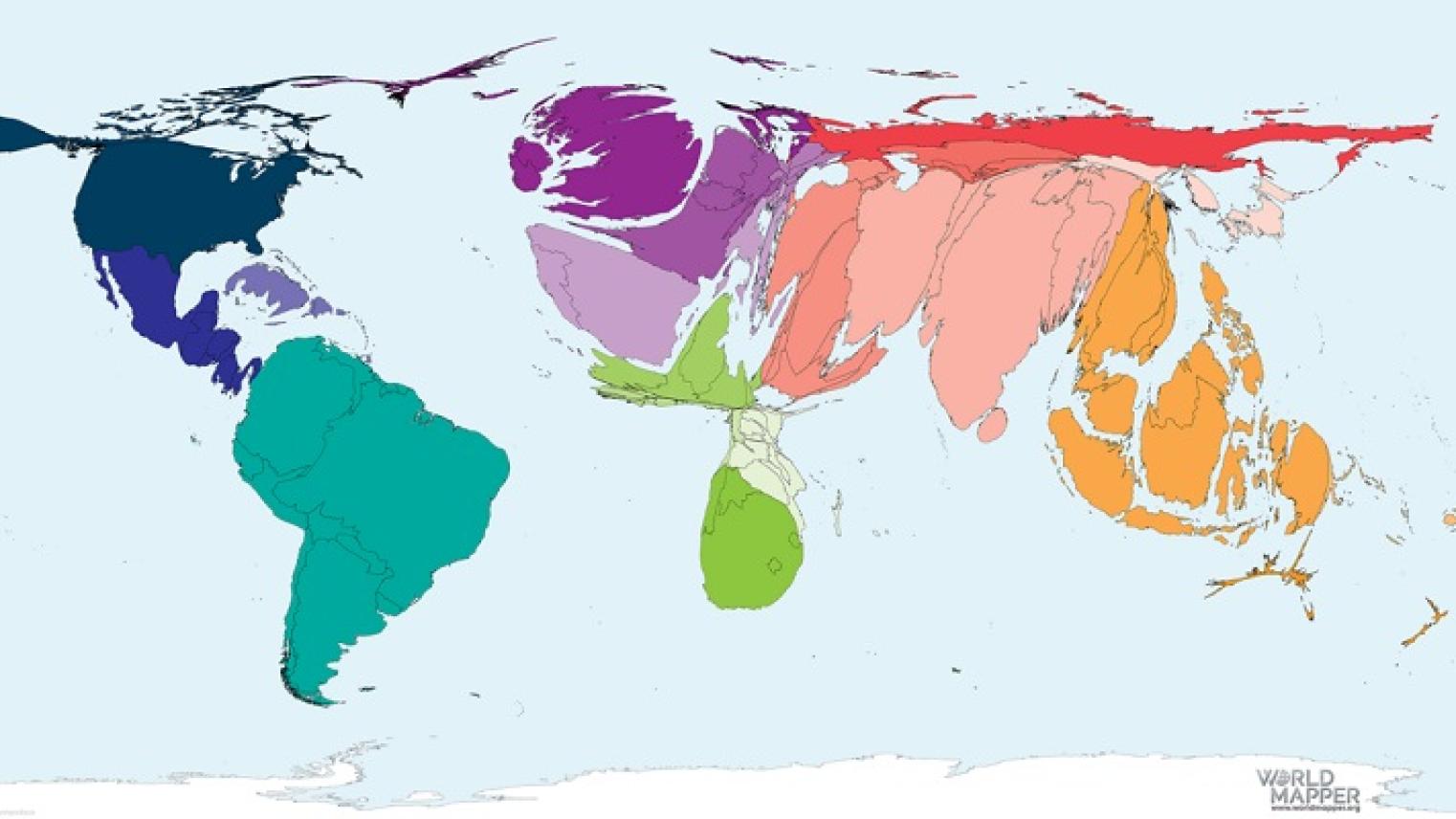
Image credit: Worldmapper map showing the proportion of new confirmed cases of Covid-19 in July 2021, using WHO data, illustrating disproportionate impact on South East Asia, from https://worldmapper.org/maps/covid-19-coronavirus-cases-july-2021/, free to user under CC BY-NC-SA 4.0 licence.