
Building knowledge and connections: Anna Fieldhouse’s journey at RegNet
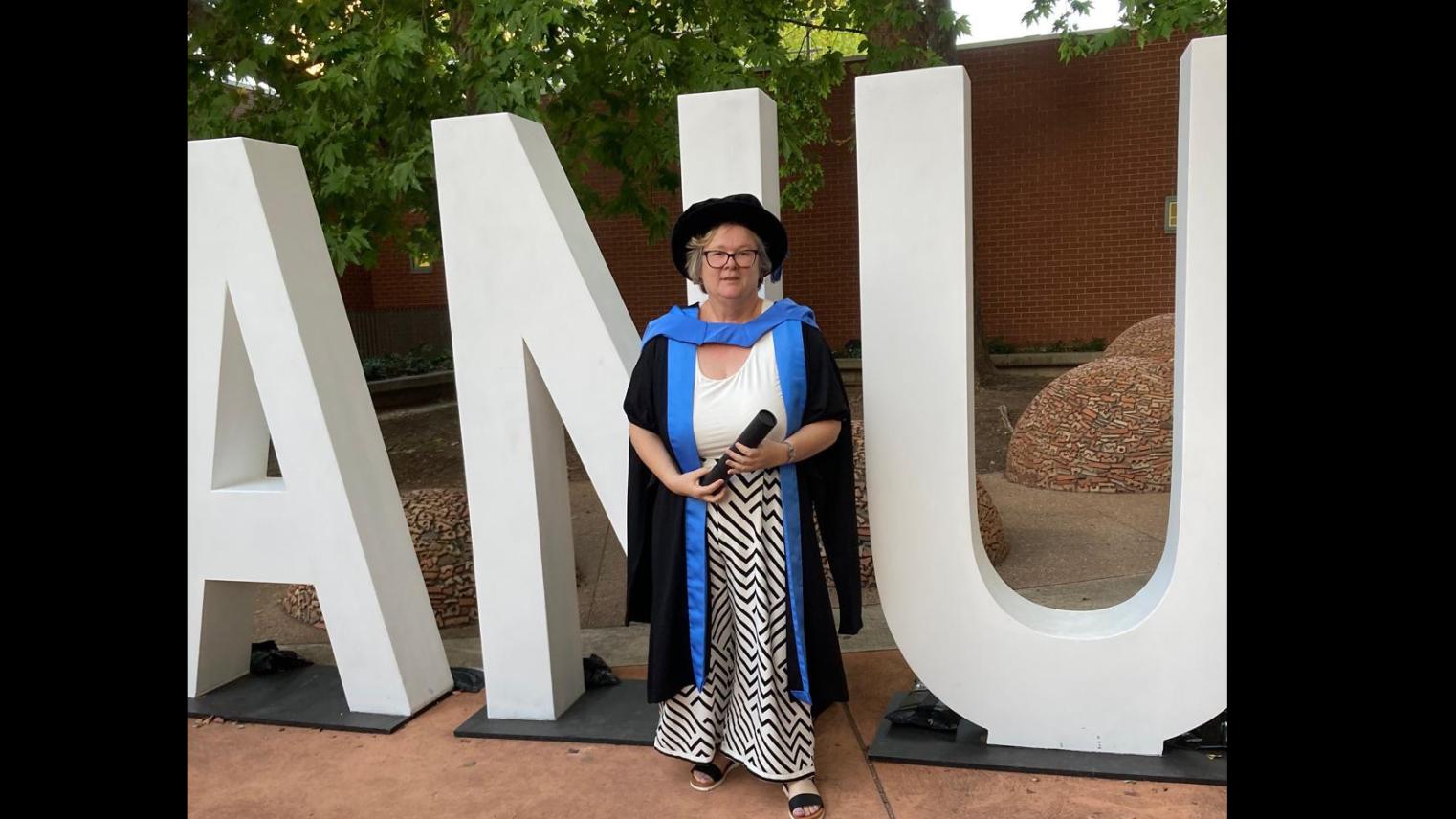
After two decades in the public service and a decade balancing part-time and full-time study, Anna Fieldhouse describes herself as a classic mid-career learner. Before embarking on her PhD, she spent many years designing and delivering social services, an experience that strongly shaped her research interests.
“After many years designing and running social services, I became increasingly interested in regulation. Regulation of social services hasn’t received nearly enough attention, particularly in an increasingly privatised sector,” Anna said.
Her work sits at the intersection of regulation and collaborative governance, an area she finds compelling because it helps explain why people comply with rules in some contexts but not others. Anna commenced her PhD at The Australian National University’s School of Regulation and Global Governance (RegNet) in 2020 after receiving a Sir Roland Wilson PhD Scholarship, supported by the Department of Social Services, and completed her thesis in late 2025.
Anna’s pathway to RegNet began several years earlier during her Master of Public Policy studies at ANU. Studying at RegNet with Professor Neil Gunningham in 2017 sparked a deeper interest in regulation, particularly the growing scholarship on regulatory intermediaries.
Her thesis examines how civil society organisations represent marginalised people within welfare service regulation, bringing together questions of democracy, regulation and governance. At its core, her research is about democracy as a critical principle of regulation, exploring how this is enacted through the work of civil society and what factors can get in the way. She chose this topic as an extension of earlier research into the role of civil society as regulatory intermediaries in the UK, and because, in her experience as a policy practitioner, civil society has a large footprint in social policy and regulatory governance — yet it was not prominent in the existing regulatory literature.
Anna began her PhD just five weeks before the first COVID lockdowns, making her part of RegNet’s first cohort to learn online. While challenging, this period also shaped some of her most memorable experiences.
As a COVID cohort, it was a real highlight learning how to build relationships online and support each other through both the PhD unknowns and even how to find toilet paper. We were the first group to do online learning, and it was a very collaborative effort. My favourite memory was doing focused ‘shut up and write’ sessions on Zoom with dear friends — our pomodoro squad — often from different countries, but it still worked.
Reflecting on her journey, Anna’s PhD has deepened her expertise and strengthened her ability to tackle complex policy challenges.
“I think I’m far more strategic in my policy advice now. I have a stronger ability to unpack complex ideas, link them to assumptions and norms and get creative about options for achieving policy goals. I really look forward to strengthening RegNet’s already stellar collaboration with regulators and government more broadly, and to work hard bringing new thinking into policy,” she said.
Her advice for aspiring PhD candidates centres on resilience rather than brilliance.
You don’t need to be the smartest or even the most disciplined student, but you do need the resilience to keep getting up when you fall over.
She recalls a pivotal moment during a research visit to Barcelona, after a long conversation with her supervisor, Associate Professor Ashley Schram, when she was feeling completely overwhelmed.
“She told me to put the pen down and take a break. A couple of hours later, I had a blinding flash of clarity and was finally able to draw out the conceptual framework that had been missing,” she said.
Like many PhD graduates, Anna is quick to acknowledge the collective effort behind the achievement.
“Every PhD student has a whole village to thank and I’m no different. RegNet has a well-deserved reputation for nurturing all its scholars, and for attracting students with extensive prior experience in their fields of study. It makes for a really rich network, and I hope that the PhD is the start of a long relationship in my intellectual life,” she said.