
Making structural advantage visible in public policy
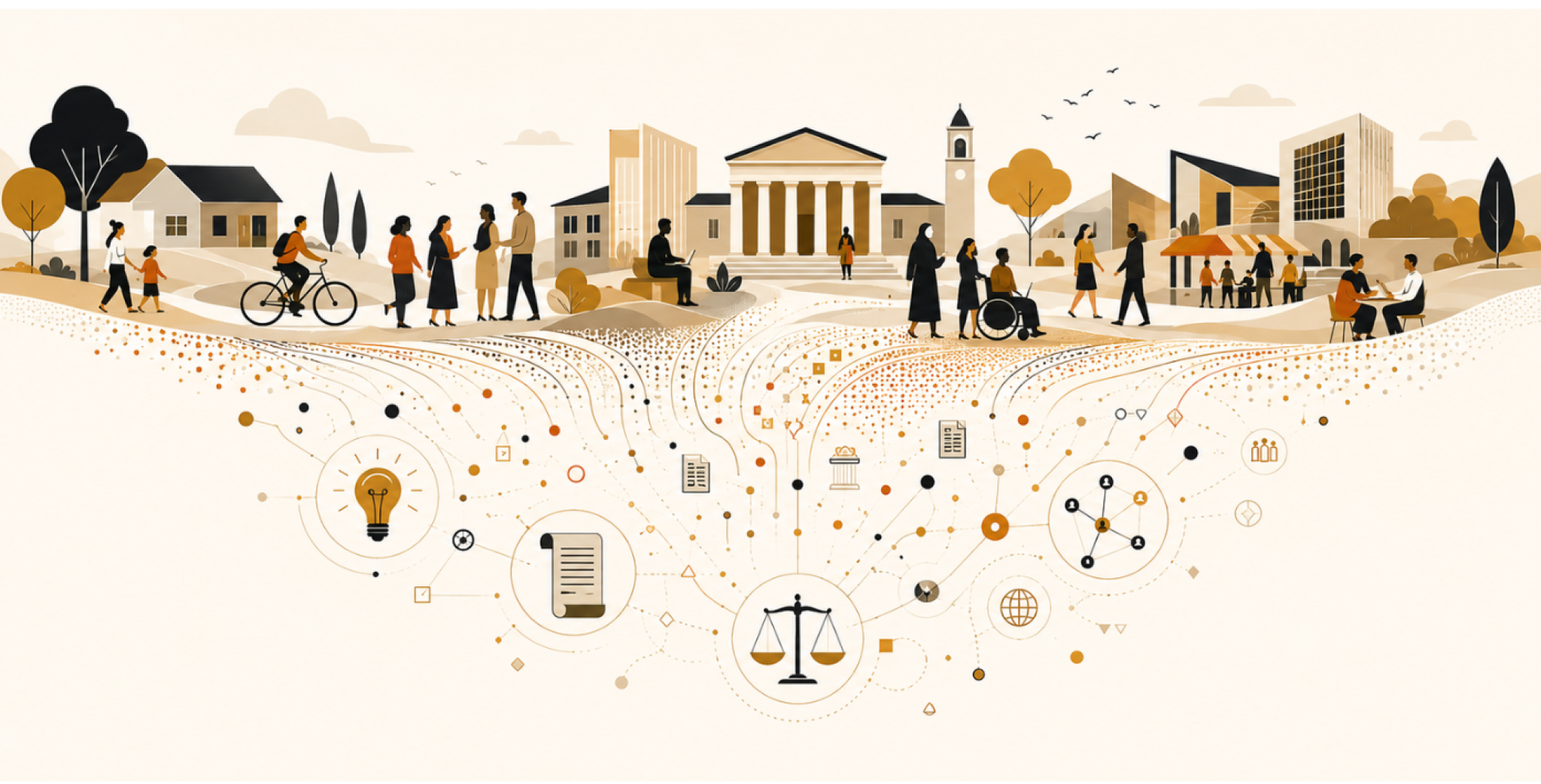
Public policies do more than respond to social problems or distribute resources. Together, they shape how economies operate, how institutions make decisions, whose needs are recognised, which forms of knowledge are valued, and what kinds of futures are made possible.
Every policy reflects choices. Some are explicit, such as which problems are prioritised, which groups receive support and who is given responsibility or control. Others are less visible, embedded in familiar assumptions, inherited institutional arrangements, accepted definitions of a problem, or the boundaries placed around the solutions considered possible. Policy also operates through silence: through the issues, perspectives, instruments and alternatives that are left out.
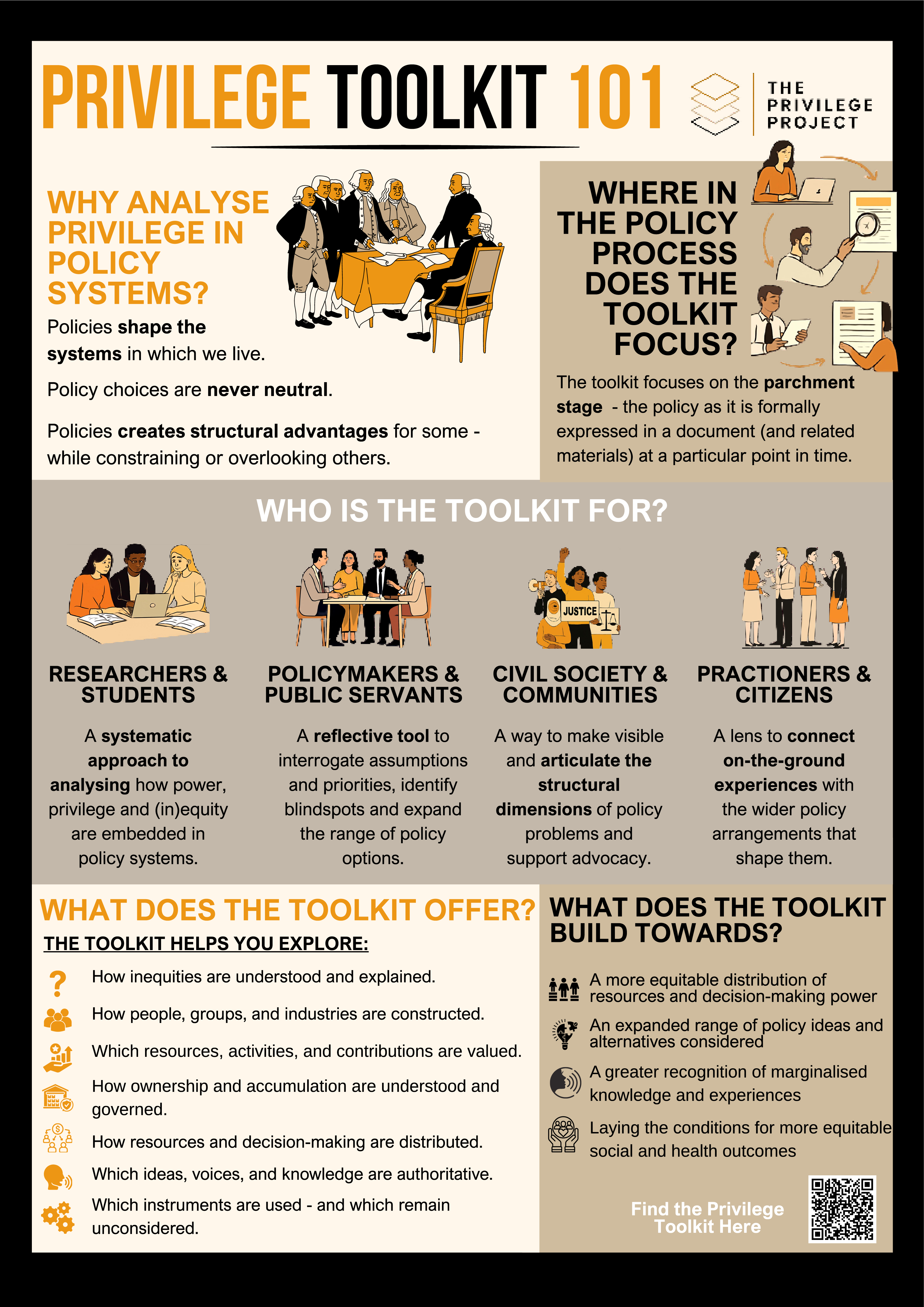
These choices are not neutral. They can create structural advantages for particular people, organisations, firms, sectors, resources and ways of knowing, while constraining or overlooking others.
The Privilege Toolkit provides a structured approach for making these dynamics visible and examining how public policy contributes to the production, reproduction or disruption of social and health inequities.
What does the toolkit examine?
The toolkit guides users through a critical analysis of the ideas, assumptions, choices, instruments and silences embedded in policy.
It helps users explore questions such as:
- How are policy problems and existing inequities understood and explained?
- Which people, identities and ways of living are recognised, supported or normalised?
- Who is positioned as responsible, deserving, productive, capable or in need of intervention?
- Which resources, activities and forms of contribution are treated as valuable?
- How are ownership, control and opportunities for accumulation governed?
- How are resources, risks, responsibilities and decision-making power distributed?
- Whose ideas, experiences and forms of knowledge are treated as authoritative?
- Which policy instruments are selected, and which alternatives remain outside consideration?
Through these questions, the toolkit supports a deeper understanding of how policy constructs different forms of advantage, including:
- Economic advantage: access to wealth, income, assets and material resources
- Political advantage: influence, representation and decision-making power
- Sociocultural advantage: recognition, status and support for particular identities and ways of living
- Epistemic advantage: whose knowledge, experiences and interpretations are heard and valued
Where does the toolkit focus?
Policy can be examined at many stages: as issues reach the political agenda, as problems and solutions are framed and contested, as policy is formally designed, and as it is implemented and experienced in practice.
The Privilege Toolkit focuses primarily on the formal articulation of policy: what has been inscribed in a policy document or related body of policy materials at a particular point in time.
Users may need to look beyond the principal document to understand its context, identify plausible alternatives or surface perspectives that the policy leaves out. However, this wider material is used to deepen the analysis of the policy itself, rather than to reconstruct the entire political process through which it was produced.
The toolkit therefore offers one point of entry into policy systems. It complements established approaches to analysing agenda setting, political contestation, problem construction and policy development rather than replacing them.
Future work will explore extending the conceptual framework into policy implementation. This will require a different suite of methods capable of examining the relational, institutional and contextual processes through which policy is interpreted, adapted, enacted and experienced.
Who is the toolkit for?
The toolkit is intended for anyone seeking to understand more deeply how policy shapes social and health inequities and where opportunities for meaningful reform may lie.
Researchers and students can use it to conduct systematic critical policy analysis, examine power and privilege within and across policy domains, and identify wider patterns of structural advantage and disadvantage.
Policymakers and public servants can use it as a reflective tool for interrogating the assumptions, priorities and distributive consequences embedded in policy design. It can help identify blind spots and expand the range of policy responses brought into view.
Civil society organisations and communities can use it to articulate the structural dimensions of policy problems, identify where inequities are being reproduced and strengthen the basis for policy engagement and reform.
Practitioners can use it to connect experiences observed on the ground with the wider policy arrangements that shape them, including why inequities may persist despite well-intentioned programs, reforms or investments.
The toolkit can be applied to:
- analyse an existing policy
- contribute to policy development or review
- compare policies across jurisdictions or time periods
- support research and teaching
- strengthen policy engagement
- identify priorities and opportunities for reform
What does the toolkit build towards?
Social and health inequities are not produced by any single policy decision. They emerge through interconnected systems of ideas, institutions, rules and resource distributions that develop across multiple areas of policy.
Addressing them therefore requires more than isolated interventions. It requires the ability to see how these systems are being constructed, where advantages are concentrated and how policy might be used differently.
By making the assumptions, choices and silences embedded in policy more visible, the Privilege Toolkit creates a stronger basis for reflection, dialogue and action.
Its ultimate purpose is not only to understand how policy systems reproduce inequity, but to help identify how they might be reshaped: by redistributing resources and decision-making power, widening the range of ideas and alternatives available, recognising marginalised knowledge and experiences, and creating the conditions for more equitable social and health outcomes.